
Falls are one of the most preventable causes of injury, hospitalisation, and loss of independence among older adults in India—yet the gap between knowing what to fix and actually fixing it remains wide. Research from urban Pune found that while 85.6% of families recognised the importance of grab bars, only 29.5% had installed them; only 14.4% used rubber bath mats despite widespread awareness . The prevalence of falls among Indian older adults ranges from 14% to 53% , and a study in Mandya found that only 34.4% of elderly participants had adequate fall-prevention awareness . This guide is not a generic list. It is a room-by-room, India-specific action plan—with concrete fixes, local costs, and practical steps for families who live in another city or abroad.
Heading Why Falls Are a Serious Risk for Indian Seniors
Indian homes present specific hazards that generic international checklists often miss. Bathrooms frequently lack separation between wet and dry areas, making floors perpetually slippery. Many homes use loose rugs, polished marble or tile flooring, and bucket bathing without grab bars. Staircases in older buildings may have single handrails or none at all. Add age-related factors—reduced balance, poor vision, medication side effects—and the risk compounds. For adult children living away, the challenge is compounded by distance. You cannot see a loose rug or a dimly lit corridor from another city. But you can assess these risks during a visit or video call, and you can act on them. The ten steps below are ordered by impact: the bathroom first, then lighting, pathways, and so on. Each includes a concrete action you can take this week.
- Fix the Bathroom First (the Highest-Risk Room)
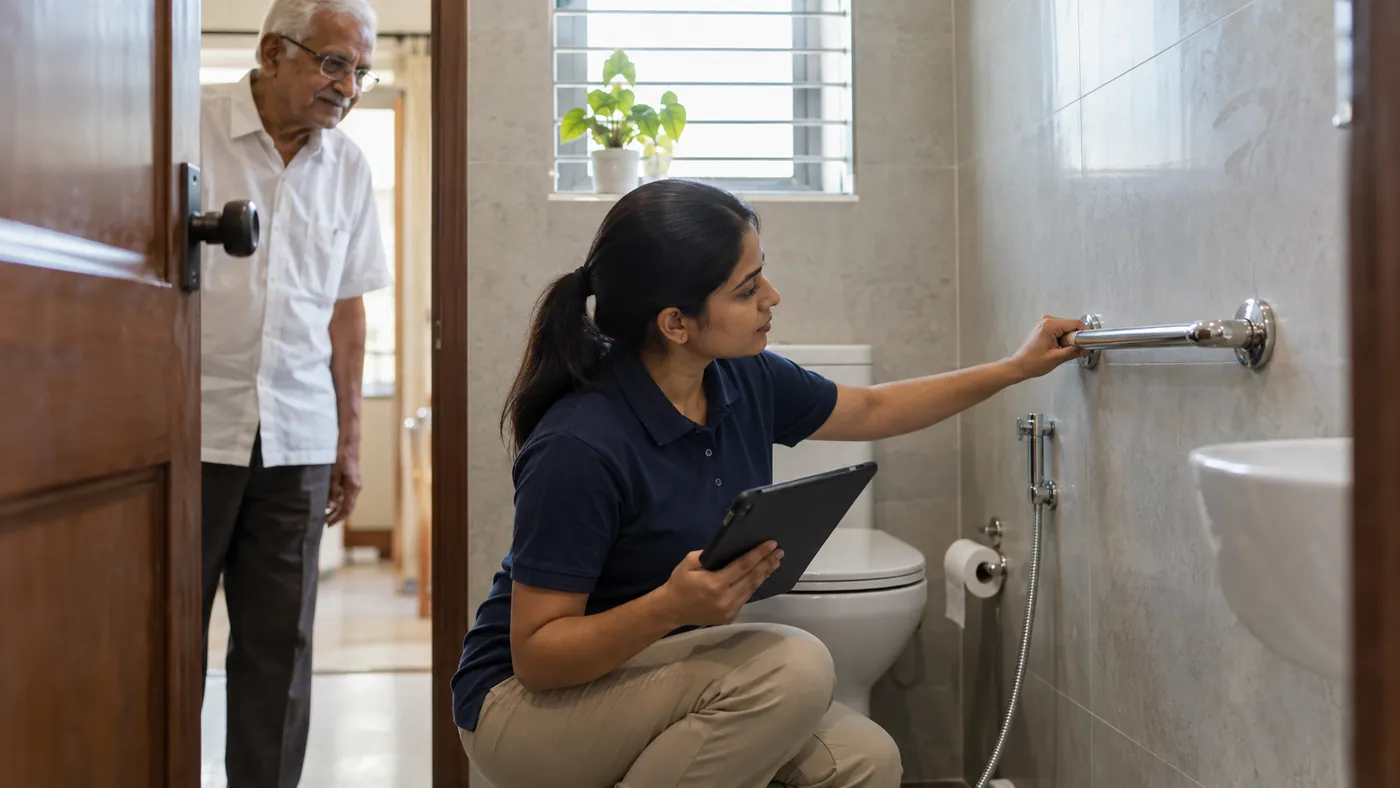
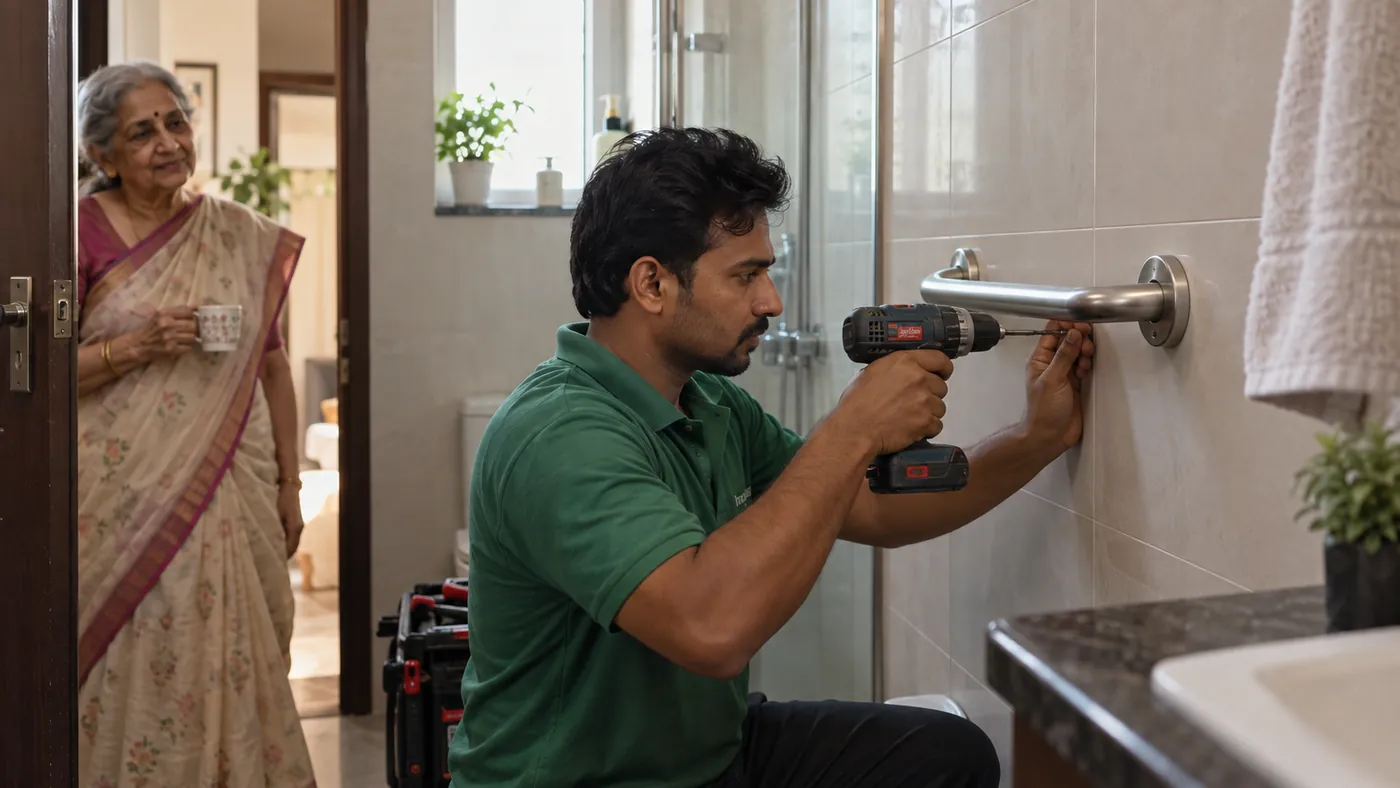
The bathroom is where falls are most frequent and most dangerous. In Indian homes, the combination of wet floors, slippery tiles, and the absence of support makes it the first priority. Concrete action: Install at least two grab bars—one beside the toilet and one inside the bathing area. Suction-mounted bars are not safe for weight-bearing; they can detach without warning. Use wall-mounted bars fixed into solid masonry. A basic stainless-steel grab bar costs ₹500–₹1,500, and a local plumber can fit it in under an hour. Place a rubber anti-skid mat inside the bathing area (₹300–₹800), and ensure the floor slopes toward the drain so water does not pool. For remote families: Ask your parents to walk you through the bathroom on a video call. Look for grab bars, mats, and whether the floor stays wet after use.
- Light the Night-Time Path to the Bathroom
Most falls in Indian homes happen at night, when an older adult wakes to use the toilet and navigates a dark corridor. Night-time bathroom trips are a well-documented fall trigger, and poor lighting makes every trip riskier. Concrete action: Install plug-in motion-sensor night lights along the route from bed to bathroom (₹300–₹700 each on Amazon India or local hardware stores). Keep a small torch or rechargeable emergency light on the bedside table. Ensure light switches are reachable from the bed without getting up. For remote families: Ask whether your parents use a night light. If not, order one online and have it delivered directly to their address.
- Remove Loose Rugs and Clutter from Walking Paths
Loose rugs, electrical cords, and everyday clutter are trip hazards that are easy to overlook because they are familiar. In Indian homes, doormats inside the house and dhurries in corridors are common culprits. Concrete action: Remove all loose rugs from walking paths or secure them with double-sided anti-skid tape (₹200–₹400 per roll). Tape down electrical cords along walls, not across floors. Clear corridors of shoes, bags, and stored items. Keep a clear path from bed to bathroom and from the main living area to the kitchen.
- Install Grab Bars and Handrails (and Where to Get Them in India)
Beyond the bathroom, handrails on stairs and grab bars near entryways provide stability for anyone with reduced balance. Concrete action: For staircases, ensure handrails on both sides where possible, and apply contrast tape (white or yellow) to the edge of each step so depth is visible. A local carpenter or hardware store can supply and fit wooden or metal handrails; expect ₹1,000–₹3,000 per metre depending on material. For entryways with steps, install a grab bar beside the door. For remote families: Kushalaya's senior home-safety assessments can identify exactly where grab bars and handrails are needed, and coordinate installation—so you have a documented record of what was fixed and why.
- Secure Stairs with Contrast Tape and Dual Handrails
Stairs are the second-highest-risk area after the bathroom. Poor lighting, missing handrails, and low-visibility step edges all contribute. Concrete action: Apply anti-slip stair treads (₹150–₹400 per step) or contrast tape to every step edge. Ensure a working light switch at both the top and bottom of the staircase. If only one handrail exists, add a second on the opposite side—this is particularly important for anyone who favours one side due to arthritis or weakness.
- Choose Safe Indoor Footwear (Not Loose Chappals)
Footwear matters more than most families realise. Loose chappals, socks without grip, and walking barefoot on smooth floors all increase slip risk. Concrete action: Provide your parents with well-fitting, closed-back slippers with rubber soles for indoor use (₹400–₹1,000). Avoid loose flip-flops. If your parents have swollen feet or diabetes, choose footwear with adjustable straps and a firm sole.
- Rearrange Everyday Items to Avoid Climbing
Reaching for items on high shelves or climbing on stools to retrieve stored goods is a common cause of falls in Indian homes, where storage is often overhead. Concrete action: Move frequently used items—medicines, glasses, phone, remote, snacks—to waist or chest height. Store heavy items on lower shelves. If your parents must reach high shelves, provide a stable step stool with a handrail rather than a chair or bucket.
- Review Medications That Cause Dizziness
Many common medications for blood pressure, diabetes, and heart conditions can cause dizziness or orthostatic hypotension (a drop in blood pressure on standing), which increases fall risk. This is a medical issue, not a home-modification one, but it belongs on this list because it is often overlooked. Concrete action: Ask your parent's doctor to review all medications—prescribed and over-the-counter—for fall-risk side effects. If your parents take multiple medications, ask whether any can be adjusted. Never change dosages without medical advice.
- Add Strength and Balance Exercises (with Physio Guidance)
Muscle weakness and poor balance are modifiable risk factors. A structured exercise programme—ideally guided by a physiotherapist—can significantly reduce fall risk. Concrete action: Ask the doctor for a referral to a physiotherapist who works with older adults. Simple home exercises (sit-to-stand from a chair, heel raises, standing on one foot while holding a counter) can be taught and practised safely. Avoid generic YouTube routines without professional guidance, especially if your parent has arthritis, osteoporosis, or a history of falls.
- Set Up a "Fall Noticed" Plan for Remote Families
Even with every precaution, a fall can happen. What matters then is how quickly someone responds. For families living in another city or abroad, this requires a plan that does not depend on the caregiver alone. Concrete action: Identify a trusted neighbour, relative, or friend who can check on your parents regularly and respond if called. Keep a written emergency plan in the home—listing the nearest hospital, the family doctor's number, and the first family contact. If your parents use a smartphone, set up an emergency contact shortcut. Consider a medical alert device or a simple daily check-in call routine. For remote families: Kushalaya's home-safety assessments provide a documented baseline of the home's condition and a record of what was changed—giving you something concrete to review with your parents and your local contact.
Sub-heading How Kushalaya Can Help
Reading a checklist is one thing; assessing your parents' actual home—room by room, hazard by hazard—is another. Kushalaya's senior home-safety services provide a structured assessment that identifies fall risks specific to your parents' home, coordinates improvements such as grab bars, anti-slip surfaces, and better lighting, and gives family members—especially those living away—a clear record of what was assessed and what was changed. Explore Kushalaya's senior home-safety assessments to request an assessment and learn how coordinated safety improvements can reduce fall risk and support your parents' independence.
Questions families ask
Are grab bars really necessary in Indian bathrooms?
Yes—especially in homes with wet bathrooms and slippery tiles. Research shows awareness is high but installation is low: 85.6% of surveyed families recognised grab bars as important, yet only 29.5% had installed them . Suction bars are not a safe substitute for wall-mounted bars fixed into solid masonry.
How much does fall-proofing a home in India cost?
Basic fixes are affordable: grab bars ₹500–₹1,500 each, anti-skid mats ₹300–₹800, night lights ₹300–₹700, and anti-slip stair tape ₹150–₹400 per step. A comprehensive assessment and coordinated installation through a service like Kushalaya provides a documented plan and avoids piecemeal purchases that may not fit correctly.
What should I check first if my parents have already had one fall?
Start with the bathroom and night-time lighting, then review medications with the doctor. A previous fall is the strongest predictor of another, so act on the highest-risk areas first and ask the doctor about a physiotherapy referral for balance training.