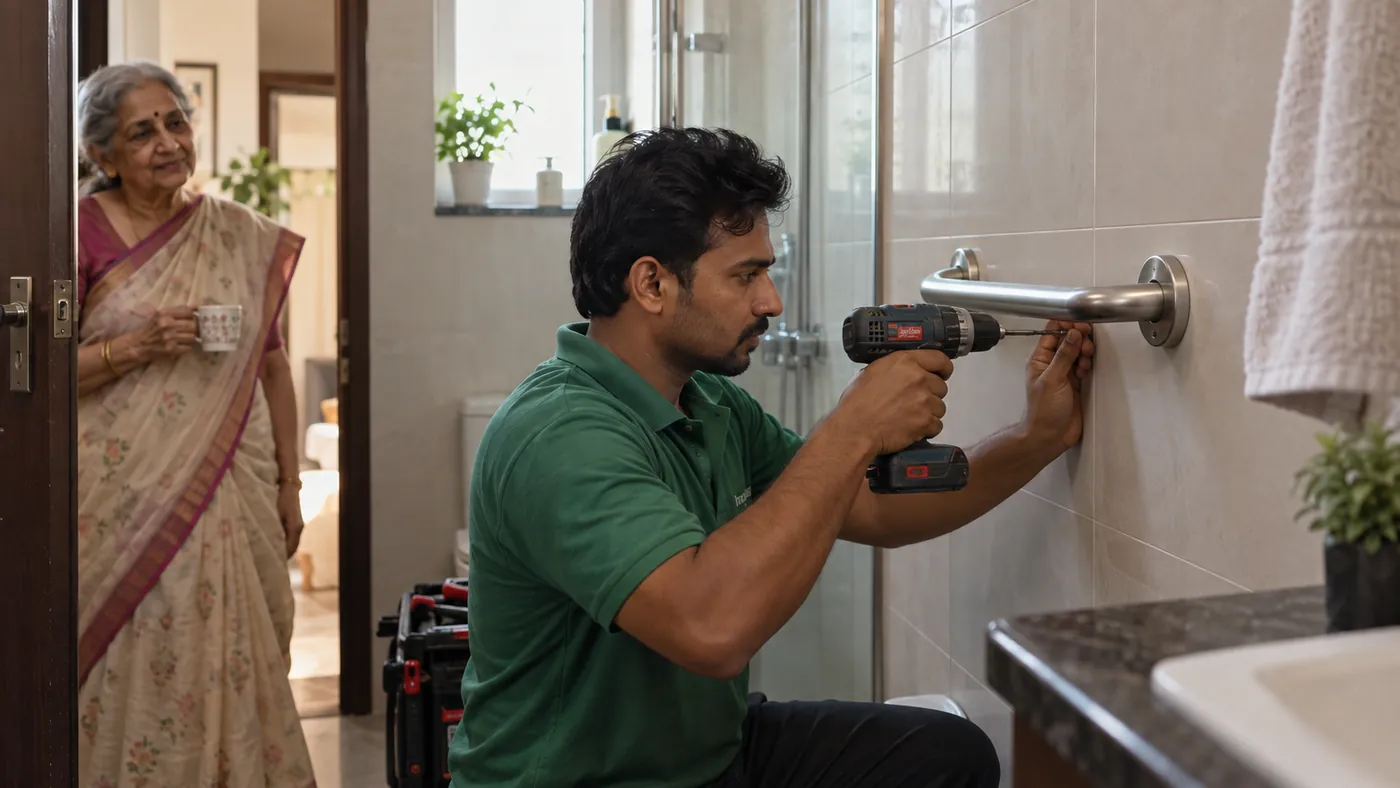
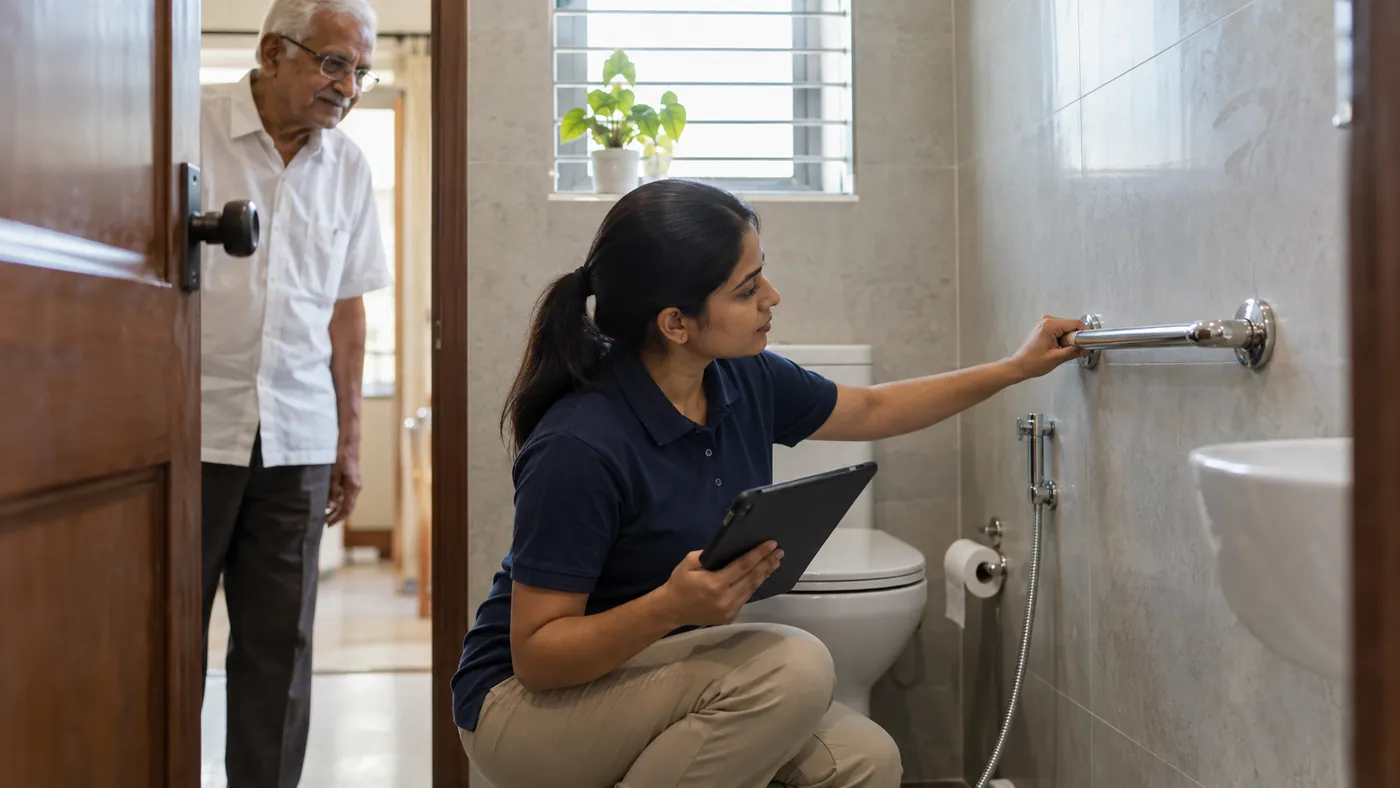
A home safety assessment for seniors in India is a structured, room-by-room evaluation of an elderly parent's home to identify fall risks, hazards, and accessibility barriers—then prioritize fixes. The core areas checked are the bathroom, bedroom, kitchen, living areas, stairs, and entryways. A professional assessment typically takes one to two hours, produces a scored report, and recommends home modifications for seniors ranging from ₹5,000 fixes (grab bars, night lights) to ₹50,000+ renovations (anti-skid flooring, level thresholds). The goal is aging in place in India—keeping parents safe, independent, and at home for as long as possible.
This guide walks you through each room, what to check, and how to act on what you find. If you are managing a parent's care from another city or from abroad, KushAlaya's KushCare Discovery is a free, scored elderly home safety assessment that produces a KushAlaya Safety Score out of 100 and a prioritized plan you can act on remotely.
What Is a Home Safety Assessment (and Why It Matters in India)?
A home safety assessment is not a vague walkthrough. It is a systematic check of every room against known risk factors—using frameworks informed by AARP and CDC home-safety guidance, adapted for Indian homes. The assessment answers three questions:
- Where are the hazards? (wet floors, loose rugs, poor lighting, missing grab bars, steep stairs)
- What is the risk level? (scored, not guessed)
- What should be fixed first? (prioritized by impact and cost)
Why Indian Homes Need a Specific Approach
Indian homes present hazards that differ from Western housing: wet bathrooms from bucket bathing, raised thresholds, glossy tiles, marble floors that become slippery when wet, tight layouts, poor ventilation, and often multi-generational homes with stairs.
These conditions make fall prevention for seniors at home a distinct challenge—and the fixes are largely about planning rather than expensive technology.
The statistics are sobering: falls are the leading cause of injury-related hospitalisation among seniors in India, and most falls happen at home. A structured elderly home safety assessment catches the risks before they cause a fall, rather than after.
The Room-by-Room Safety Assessment
Use this senior home safety checklist to evaluate each room. Mark each item as safe, needs attention, or urgent.
1. Bathroom (Highest Risk)
The bathroom is where most serious falls happen. Check:
- Floor: Is it anti-skid when wet? Are there loose mats or rugs? In Indian homes where bucket bathing is common, the entire floor becomes a wet zone—anti-skid coverage must extend beyond the shower area.
- Toilet: Can your parent stand up without holding something unstable? Is the pan too low? Are grab bars installed beside the toilet?
- Shower/bathing area: Is there a step to get in? Is there anywhere to sit? Are grab bars within reach? Is the hand shower reachable without stepping into the wet zone?
- Door: Does it open outward or slide? Can it be unlocked from outside in an emergency?
- Lighting: Can your parents see the route to the bathroom at night without turning on bright overhead lights?
- Water: Is the temperature capped at 49°C? Are controls reachable without entering the wet zone?
Priority fixes: Anti-skid flooring, grab bars beside toilet and shower, night lighting, shower seat.
2. Bedroom
The bedroom is where the night-time routine creates risk—especially the route to the bathroom. Check:
- Bed height: Can your parent get in and out easily, with feet flat on the floor?
- Bedside support: Is there a stable surface to hold when getting up? Is there a bedside lamp within reach?
- Night route: Is there a clear, lit path from bed to bathroom? Are there loose rugs or furniture in the way?
- Floor: Are there loose carpets, trailing wires, or clutter?
- Emergency access: Can a caregiver or family member enter if your parent falls?
Priority fixes: Night lights on the bed-to-bathroom route, remove loose rugs, bedside grab handle.
3. Kitchen
The kitchen combines fire, sharp objects, hot liquids, and standing—a high-risk combination for seniors. Check:
- Reach: Are frequently used items stored between waist and shoulder height, not on high shelves or low cabinets?
- Floor: Is it anti-skid when wet? Are there spills left unattended?
- Lighting: Is the counter and stove area well-lit?
- Gas safety: Is there a gas leak detector? Are stove knobs clearly marked? Is the gas turned off after use?
- Seating: Is there a stool or chair for tasks that require standing?
- Storage: Are heavy items stored at waist height?
Priority fixes: Anti-skid mats, reachable storage, task lighting, gas safety check.
4. Living Areas
Living rooms and dining areas are where trips and falls from clutter happen. Check:
- Floor: Are there loose rugs, trailing wires, or clutter? Are there small objects on the floor?
- Furniture: Are chairs and sofas stable and at the right height for easy sitting and standing? Are there sharp corners?
- Lighting: Is the room well-lit, especially in the evening?
- Pathways: Are there clear paths between rooms, with no furniture in the way?
- Pets: Are there pet bowls, toys, or pets underfoot?
Priority fixes: Remove loose rugs, secure wires, add task lighting, clear pathways.
5. Stairs and Steps
Stairs are the most dangerous feature in a multi-level home. Check:
- Handrails: Are there handrails on both sides? Are they stable and at the right height?
- Steps: Are the steps of uniform height? Are the edges marked with contrast strips?
- Lighting: Are the stairs well-lit, with switches at both top and bottom?
- Flooring: Is the stair surface anti-skid? Are there loose carpets or worn edges?
- Clutter: Are there objects stored on the stairs?
Priority fixes: Handrails on both sides, contrast strips on step edges, lighting at both ends, remove clutter.
6. Entryways and Outdoor Areas
The entryway is where the transition from outside to inside creates risk. Check:
- Thresholds: Are there raised thresholds to step over? Are they marked?
- Lighting: Is the entry well-lit at night?
- Floor: Is the entry floor anti-skid when wet?
- Steps: Are there steps to enter the home? Are there handrails?
- Door: Is the door easy to open and close? Is the lock easy to operate?
Priority fixes: Mark thresholds, add lighting, install handrails on entry steps.
Home Modifications for Seniors: What to Fix First
Not every fix requires a renovation. The home modifications for seniors that matter most are often the cheapest. Here is a priority order:
Tier 1: Low-Cost, High-Impact (₹5,000–₹25,000)
- Night lights on the bed-to-bathroom route
- Grab bars beside toilet and in shower (if backing exists)
- Non-slip mats in bathroom and kitchen
- Remove loose rugs and clutter
- Contrast strips on stair edges
- Bedside lamp within reach
Tier 2: Moderate Cost (₹25,000–₹75,000)
- Anti-skid flooring in bathroom
- Shower seat or fold-down bench
- Raised toilet seat
- Hand shower on a rail
- Handrails on stairs
- Task lighting in kitchen and bathroom
Tier 3: Renovation-Level (₹75,000–₹2,00,000+)
- Level shower threshold
- Outward-opening or sliding bathroom door
- Full bathroom re-tiling with anti-skid surface
- Widening doorways for wheelchair access
- Stairlift or ramp installation
The key principle: Provide for the expensive-to-retrofit items (blocking behind tile, lighting circuits, anti-skid floor, door swing direction) during any renovation, even if you do not fit the visible fixtures yet. This is the cheapest possible version of being ready.
Aging in Place in India: Why This Matters
Aging in place in India means keeping parents in their own home—familiar surroundings, community, and dignity—rather than moving them to a care facility. For many Indian families, this is not just a preference; it is a cultural expectation and a source of emotional well-being.
But aging in place requires a safe home environment for elderly parents. The home must be modified to match their changing needs—before a fall forces the issue. A room-by-room safety assessment is the starting point: it tells you what to fix, in what order, and at what cost.
The alternative—waiting for a fall—is far more expensive. A hip fracture can cost ₹2–5 lakh in hospital bills, followed by months of rehabilitation and a permanent loss of independence. The senior citizen home safety tips in this guide cost a fraction of that, and they prevent the event entirely.
Senior Citizen Home Safety Tips: A Quick Checklist
For families who want a fast start, here are the senior citizen home safety tips that matter most:
- Walk the bathroom first—it is the highest-risk room. Check the floor, grab bars, and night lighting.
- Light the night route from bed to bathroom. This is the cheapest, highest-impact change.
- Remove loose rugs and clutter from all walking paths.
- Install grab bars beside the toilet and in the shower—but ensure solid backing.
- Mark step edges with contrast strips on stairs and thresholds.
- Cap water temperature at 49°C to prevent scalds.
- Keep frequently used items between waist and shoulder height.
- Check handrails on stairs—both sides, stable, right height.
- Ensure a caregiver or family member can enter if your parent falls behind a locked door.
10.Get a professional assessment if multiple items are unchecked—guessing from photos misses what a trained eye catches.
The Bottom Line
A home safety assessment for seniors in India is the starting point for aging in place—keeping parents safe, independent, and at home. The senior home safety checklist in this guide covers every room, and the priority order tells you what to fix first. Start with the bathroom and the night route—they are the cheapest and the highest-value. Plan the expensive-to-retrofit items during any renovation. And if you are managing care from another city or from abroad, get an assessment before you get a contractor.
KushAlaya provides elder care at home across India, beginning with a free KushCare Discovery assessment and a KushAlaya Safety Score that tells families exactly where the risks are—and what to fix first.
Questions families ask
What is a home safety assessment for seniors in India?
A home safety assessment for seniors in India is a structured, room-by-room evaluation of an elderly parent's home to identify fall risks, hazards, and accessibility barriers. It produces a scored report and a prioritized plan for home modifications for seniors. A professional assessment typically takes one to two hours and covers the bathroom, bedroom, kitchen, living areas, stairs, and entryways.
How much does a home safety assessment cost in India?
Costs vary. KushAlaya's KushCare Discovery is a free, scored assessment that produces a KushAlaya Safety Score out of 100 and a prioritized plan. Some providers charge ₹2,000–₹5,000 for a standalone assessment. The assessment itself is inexpensive compared to the cost of a fall—a hip fracture can cost ₹2–5 lakh in hospital bills.
What are the most important home modifications for seniors?
The highest-impact, lowest-cost modifications are night lighting on the bed-to-bathroom route, grab bars beside the toilet and in the shower, anti-skid flooring in the bathroom, and removal of loose rugs and clutter. These address the situations where most falls happen. Renovation-level changes—level thresholds, outward-opening doors, anti-skid re-tiling—should be planned during any renovation.
How do I know if my parent's home is safe for aging in place?
A room-by-room safety assessment is the most reliable way. Walk each room with the checklist in this guide, marking items as safe, needs attention, or urgent. If multiple items are unchecked—especially in the bathroom and on stairs—a professional elderly home safety assessment will catch risks that are easy to miss and prioritize fixes by impact and cost.
My parents live in India and I am abroad. How do I arrange a home safety assessment?
KushAlaya's KushCare Discovery is a free, scored assessment that covers the home room by room and produces a KushAlaya Safety Score and a clear plan you can act on remotely. The care manager visits the home, documents risks with photos, and provides a prioritized report—so you can make decisions from abroad with confidence.